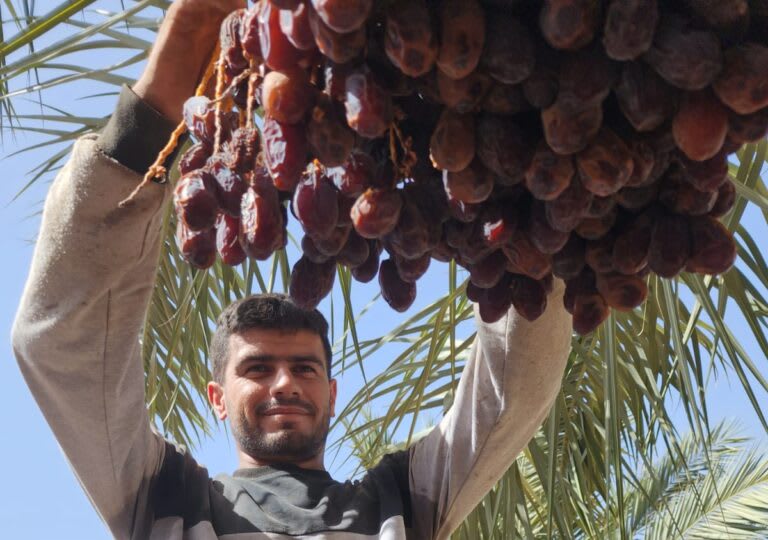

With Ramadan just weeks away, pressure is mounting on farming communities across the Jordan Valley.
Our focus this time is on Al-Auja, a town known for its natural spring, which has historically enabled farming to flourish. Today, it is making headlines for very different reasons. Farmers and herders here – as across much of the Jordan Valley – are facing growing threats to their ability to farm, earn a living, and remain on their land.
The pressures are layered and mutually reinforcing. Water access, already scarce due to climate stress and long-standing inequalities in allocation, is further constrained by policies and restrictions that make irrigation and even basic farming increasingly difficult. This alone undermines agricultural viability, leading to crop losses and shrinking harvests.
Alongside this, violence and displacement have intensified. In recent months, Reuters has reported on the forced displacement of Palestinian communities across the West Bank, including in and around the Jordan Valley, following sustained settler violence that has made daily life untenable for many rural families.
As Reuters reports, families were “forced out after years of harassment and violence by Israeli settlers,” describing a situation in which remaining on the land was no longer possible.
This pattern is evident in Al-Auja itself, where Bedouin families have been pushed out after years of harassment, blocked access to grazing land, and the expansion of nearby settler outposts. By late 2025 and early 2026, dozens of families had packed up and left, describing a reality where insecurity had become constant rather than exceptional.
Water remains a critical fault line throughout the Valley. Journalists and human rights organisations have documented how springs and water infrastructure traditionally relied on by Palestinian communities have been taken over or rendered inaccessible, accelerating displacement and making farming increasingly untenable.
This is close to our hearts. Several Palestinian packing houses and sorting facilities – including long-term suppliers we work with directly – are based in Al-Auja, in the heart of the Jordan Valley. People there are still trying to live, farm, harvest, sort and pack produce, even as daily life becomes increasingly precarious.
The struggle to maintain roots in a place that many external forces are trying to reshape is real. It affects jobs, food security, income, and the ability of farming communities to withstand mounting pressure – now and into the future.
We are repeatedly reminded that farming in Palestine is an act of survival, identity and resistance.
Thirty Palestinian families left their home in a remote area of the Israeli-occupied West Bank on Friday, saying they were forced out after years of persistent harassment and violence by Israeli se…
“There is nothing harder than dismantling your own home,” said Husseini Rashid, 40, as he hoisted sheep onto a truck. “We were expelled from Masafer Yatta in 1967 and came here. Now it’s happening again – this is a Nakba”
Other recent posts